How to Choose the Right Photographer for Your Family Holiday in Mauritius
You've booked the resort. You've finally made it out of the chat. You’ve landed in paradise. Everyone's actually in the same place at the same time. And somewhere in the planning, it hit you: we should get photos of this. So you open a tab and start searching. And within about ten minutes, you're overwhelmed. This guide will help you cut through the noise; not with a checklist, but with the things that actually matter when you're choosing someone to photograph your family on holiday in Mauritius.

The signal that tells you everything
Here's where I start when a family reaches out to me. Within the first line of an inquiry, I can usually tell whether the session is going to go beautifully or not. The families who have the best experiences? They write something like: "We love your work and the natural way you capture families." They've looked. They've felt something. They already trust the approach before we've even spoken. That level of alignment - between what a photographer does and what you're actually hoping for - is the single most reliable predictor of a great experience.
So before anything else: do you love what you're looking at? Not just the locations or the light, but the people in the images. Do they look like themselves?

The most common mistake families make in Mauritius
This one is specific to shooting here, and it doesn't come up if you're booking a photographer back home.
Choosing a hotel photographer to save money
I understand the logic. You're already at the resort, there's a photographer on-site, it feels convenient. But there's something worth understanding about how hotel photography works that goes beyond style or price. A hotel photographer's client is the hotel. Their brief, whether it's explicit or just understood, is to make the resort look aspirational. Beautiful people, beautiful setting, beautiful brand. Your family is essentially part of the backdrop. When you book an independent photographer, you are the client. The brief is entirely different: to make you look like yourselves, at your best, in a place you love. That shift in who the photographer is actually serving shows up in every image. There's also this: a professional family session costs roughly the same as a nice dinner out. A fancy dinner is a memory by morning. The images from a session will live on your walls, in your phone, in your family's hands, for decades. They're the only souvenir from this trip that actually gains value over time.
Budget for photography the same way you'd budget for an experience worth keeping.
What to actually look at in a portfolio
Most people scroll portfolios looking at locations and light. Both matter; but neither tells you whether a photographer knows what they're doing with real people.
What gives it away is this: do the people look stiff? Posed, rigid, slightly uncomfortable images signal a photographer who knows how to set up a frame but not how to put people at ease.
The images might be technically beautiful. But if you can feel the effort in the subjects' faces, you'll feel it in yours too. What you want to see is presence. Laughter that looks accidental. Kids who've forgotten there's a camera. Parents who look like they actually like each other. That's the hard part of this job, and it's not faked.

What a session actually feels like
No two sessions are the same; a family with a big kid and two toddlers needs something completely different from a couple celebrating an anniversary, and a multigenerational reunion has its own shape entirely.
What I can tell you is what tends to happen with natural family photography in Mauritius because experience leaves patterns.
I arrive early to every session. I've already walked the location, found the light, decided where we're going. So when a family pulls up, we start walking and talking, not photographing. You've already done the hard part. Everyone is here. Everyone looks great. I tell the parents this, almost always the mum first. It usually lands. We talk on the way to the spot. I share a bit about myself; I have three kids, I understand the chaos - and I ask about themselves. By the time we reach the location, we're not strangers.
Then I set the tone. I tell them I'll guide them into natural interactions. That this is their time to be affectionate, present, and a little bit ridiculous with each other. To embrace the chaos if their kids are wild, because that's going to make for the most beautiful images. From there, the session finds its own rhythm. There's usually a gentle warm-up: walking together, holding hands, maybe dancing a little to their child's favourite song.
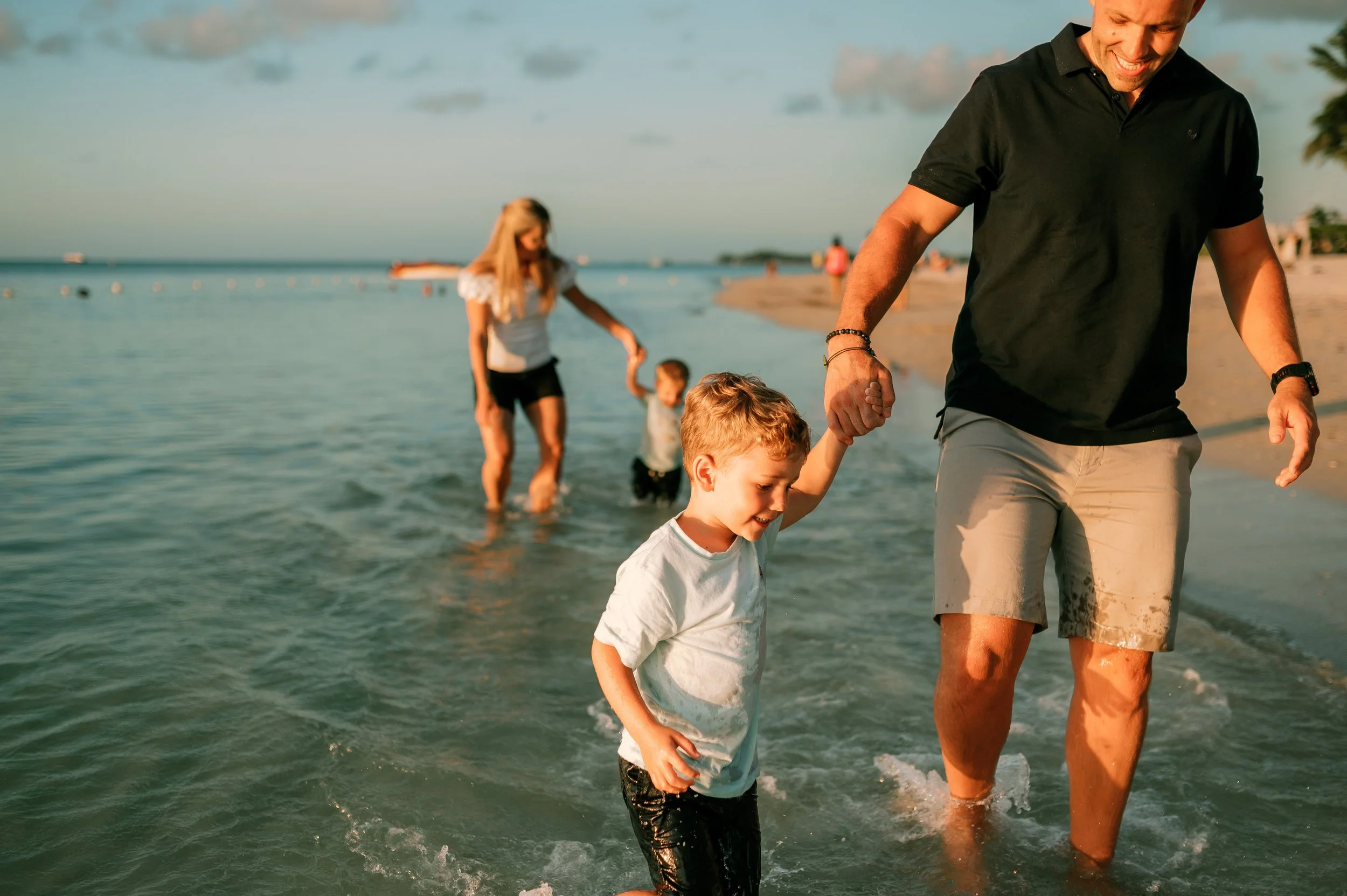
Then whatever unfolds from there: spinning the kids, races along the sand, throwing them in the air. The specific moments are different every time. What stays the same is the intention: to keep things moving, keep people connected, and stay ready for the real moments.
Toward the end, I usually pull the parents aside. A silhouette with the sunset. A quiet moment together while the kids run. Then the whole family watching the sun go down. We usually keep talking long after the camera goes away. I thank them, tell them what happens next, say goodnight, and high-five the kids on the way out.
That's what it's supposed to feel like. An experience of just being together.

The questions almost nobody thinks to ask
Before you book, ask your photographer two things:
How do you direct people while still getting natural results?
This question separates photographers who have genuinely thought about their craft from those who are just pointing a camera and a flash. There's no one right answer; but there should be an answer. A real one, with some specificity.
What do you do when a child doesn't want to participate?
This is the most revealing question you can ask. Any experienced family photographer has been here. A three-year-old who plants themselves in the sand and refuses to move. Or has a laser focus on finding crab holes. An eight-year-old who decides the whole thing is embarrassing. What does your photographer do?
My approach: I give them space. I encourage the parents to hold them close and keep it gentle and connected. If the child stays shy, we work with that; sometimes the most tender images come from a little one tucked into a parent's chest, not willing to look at the camera. And usually, somewhere around the halfway mark, they warm up. When they do, I'm ready. If a child won't sit still? I stop trying to pose them and become an action photographer. Running, jumping, spinning; I capture their energy rather than fight it.
A photographer who hesitates on this question is telling you something important.

What makes Mauritius different
There are beautiful places to be photographed all over the world. But there's something specific about shooting families here that I don't think gets said enough. The scenery is obviously stunning. The light in the golden hour is extraordinary. But the real difference is something you bring with you: you're on holiday. There's no school. No work. No weekend sports schedules pulling anyone in six directions. Families who come here are already more relaxed, more present, more connected to each other than they are in ordinary life. That state of mind does half my job for me. The images we make on a beach in Mauritius look different from the ones made in a park on a Saturday morning back home, and it's not just the coconut palms. It's the fact that you've actually arrived somewhere. Together.

When things don't go to plan
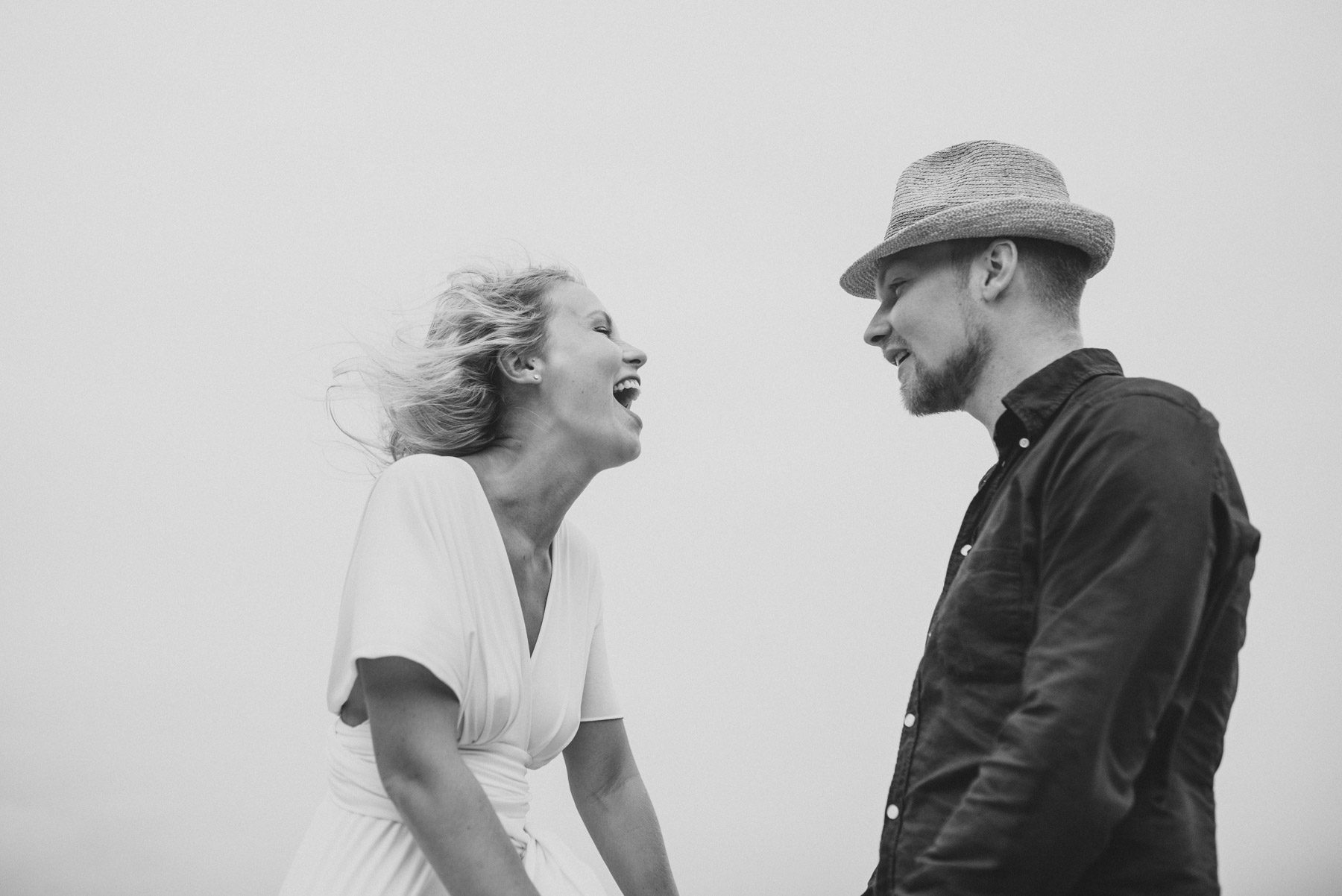
Some of my favourite sessions are the ones that fell apart in some way first. I once photographed a couple on honeymoon in conditions that can only be described as a cyclone-adjacent storm. We could have rescheduled. Instead, we went. The wind, the drama, the grey sky; it became one of my most extraordinary sessions to date.
More recently, a client wrote in her review that she'd been worried about rain before her session. I suggested we go ahead anyway. She said she was so glad we did. Weather here is moody and fast-changing. A photographer who has worked in these conditions and who knows how to adapt, how to read the sky, how to turn unexpected light into something - is worth more than one who's only ever shot on perfect evenings. Ask your photographer how they handle it when conditions change.
The answer will tell you a lot.
What to look for in reviews
Testimonials that say "she was amazing" or "we loved every minute" are nice. They don't tell you much. What you're looking for is specificity.
"She noticed our son was shy and just gave him time. Twenty minutes in, he was running into her arms."
"She got down on the sand with our toddler."
"She messaged us the night before to check we knew where to park."
Those details signal a photographer who is actually present and paying attention; not just delivering a service. The specific things clients remember are usually the things that made them feel cared for. That's what you want.
How to think about price
Photographers in Mauritius range widely in price. And experience. Here is the honest framing I'd offer: You're on a trip that cost thousands of euros to make happen. You've brought your family to one of the most beautiful places on earth. You have maybe one or two evenings where the light and the moment align. The images from that evening will outlast everything else about this trip. The restaurant you loved? You'll forget the name within a year. The sandcastle your kids built? It washed away by morning.
The photographs? They sit on walls, get handed down, show up on screens twenty years from now.
It is the only souvenir that compounds.
Spend accordingly.

When you're down to two and can't decide
Here's what I'd tell you to do: stop reading the reviews and stop comparing the packages. Look at both portfolios one more time; slowly, honestly, and ask yourself: can I see my family in these images? Not just the style. Not just the light. Do the families in those photos feel like your kind of family? Do you look at the images and feel something, or do you just admire them from the outside?
The photographer whose work makes you feel seen before you've even met them is almost certainly the right one.
Trust that instinct. It's usually the most reliable thing in the whole decision.
Sita Kelly is a professional photographer based in Tamarin, Mauritius. She photographs families, couples, and extended groups visiting the island; specialising in natural, connected sessions that feel more like an evening on the beach than a photoshoot. Find out more at sitakellyphotography.com